You're all caught up—no notifications available.
Explore All Exams at KGS


All Exams
Explore All Exams at KGS

Khan Sir Courses
Geography I Polity I History | World Map I Indian Map I Economics I Biology

UPSC & State PSC
UPSC I BPSC I UP-PSC I MP-PSC

State Exams
UP I Bihar I MP | Rajasthan

NEET | JEE | CUET | Boards
NEET | JEE | CUET | Boards

Defence Exams
NDA I CDS I CAPF I AFCAT I SSB I Agniveer

Police Exams
UP SI | Bihar SI | Delhi Police | UP Constable

SSC Exams
CGL I CPO I CHSL I MTS I SSC GD I Delhi Police

Foundation Courses
Physics I Chemistry I Biology I History I Geography I Polity I NCERT I Math I English | Map I Reasoning

Railway Exams
RRB | RPF

Teaching Exams
TET | Teaching | UGC

Banking Exams
SBI | RBI | IBPS

Engineering Exams
Civil | Electrical | Mechanical
UGC NET
UGC NET/JRF
Current Affairs provides you with the best compilation of the Daily Current Affairs taking place across the globe: National, International, Sports, Science and Technology, Banking, Economy, Agreement, Appointments, Ranks, and Report and General Studies

SYLLABUS
GS-3: Environment Conservation
GS-2: Agreements involving India and/or affecting India’s interests.
Context: Recently, the Union Minister for Environment, Forest and Climate Change, released nine cheetahs received from Botswana into quarantine enclosures at Kuno National Park in Madhya Pradesh as part of India’s cheetah reintroduction programme.
More on the News
• With the arrival of the six female and three male cheetahs, the total cheetah population in India has increased to 48, which includes 28 India-born cubs and 20 adult cheetahs translocated from African countries under Project Cheetah.
• This marks the third batch of cheetahs brought from an African nation under the translocation programme, following the first batch of eight cheetahs from Namibia in September 2022 and another 12 cheetahs from South Africa in February 2023.
• The initiative represents the world’s first intercontinental translocation of cheetahs aimed at restoring the species in the wild.
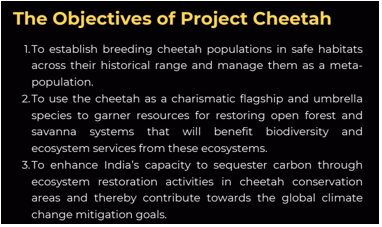
• The transfer is part of a government-to-government agreement designed to establish a genetically diverse and free-ranging cheetah population in India over the next decade.
Why was Kuno National Park chosen for the Cheetah Reintroduction?
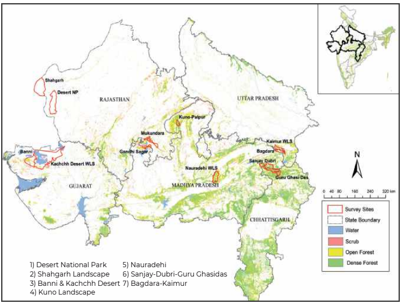
• Kuno National Park, located in Madhya Pradesh, received the highest rating among surveyed sites, making it the most suitable location for the cheetah reintroduction programme in India.
• The park offers a vast and contiguous landscape within the Sheopur–Shivpuri Forest region, covering about 6,800 sq km, which provides sufficient space for the movement and expansion of cheetah populations.
• Its habitat conditions are highly conducive for cheetahs, with suitable terrain and adequate prey resources necessary for sustaining the species in the wild.
• The park falls under the Northern Tropical Dry Deciduous Forest category as per the forest classification of H. G. Champion and S. K. Seth (1968), which supports a favourable ecological environment for cheetahs.
• As of March 2026, Gandhi Sagar Wildlife Sanctuary in Madhya Pradesh has become the second habitat for cheetahs in India after their initial reintroduction at Kuno National Park, and the sanctuary currently hosts three cheetahs.
About Cheetah
• The cheetah (Acinonyx jubatus) is the fastest land animal and Africa’s most threatened big cat.
• It can accelerate to over 110 km/h (about 70 mph) in just over three seconds and can cover strides of up to seven metres.
• The name “Cheetah” originates from the Sanskrit word “Chitra”, meaning “the spotted one”.
• Cheetahs play an important ecological role and are considered keystone species and apex predators in savanna and grassland ecosystems.
• International Cheetah Day is observed annually on December 4 to raise awareness about the conservation of the species.
• Physical Characteristics:
• Global Distribution:
• Conservation Status:
The Saga of Cheetah Reintroduction in India
• Formal efforts to reintroduce cheetahs in India began in the 1970s, when discussions were initiated with Iran for the relocation of the Asiatic cheetah, followed later by negotiations with Kenya.
• In 2009, India proposed introducing cheetahs from Africa, a proposal that required clarification from the Hon. Supreme Court of India. In 2020, the Court permitted the import of a limited number of cheetahs for an experimental reintroduction programme.
• Following these directions, Project Cheetah was officially launched in 2022 under the supervision of the National Tiger Conservation Authority (NTCA), with the Cheetah Reintroduction Programme forming its central component.
• After a Memorandum of Understanding was signed between India and Namibia to promote wildlife conservation, the first batch of eight cheetahs (five females and three males) was translocated to Kuno National Park in Madhya Pradesh on September 17, 2022.
• The second batch of 12 African cheetahs (seven males and five females) arrived from South Africa at Kuno National Park in February 2023, further strengthening the reintroduction programme.
Source:
PIB
Indian Express
The most trusted learning platform on your phone
With our training programs, learning online can be a very exciting experience! Take the next step toward achieving your professional and personal objectives



Course Related Query:
Ask Your DoubtsStore Related Query:[email protected]NCERT Books
Resources
We love learning. Through our innovative solutions, we encourage ourselves, our teams, and our Students to grow. We welcome and look for diverse perspectives and opinions because they enhance our decisions. We strive to understand the big picture and how we contribute to the company’s objectives. We approach challenges with optimism and harness the power of teamwork to accomplish our goals. These aren’t just pretty words to post on the office wall. This is who we are. It’s how we work. And it’s how we approach every interaction with each other and our Students.
Come with an open mind, hungry to learn, and you’ll experience unmatched personal and professional growth, a world of different backgrounds and perspectives, and the freedom to be you—every day. We strive to build and sustain diverse teams and foster a culture of belonging. Creating an inclusive environment where every students feels welcome, appreciated, and heard gives us something to feel (really) good about.
Get Free academic Counseling & Course Details