Explore All Exams at KGS


All Exams
Explore All Exams at KGS

Khan Sir Courses
Geography I Polity I History | World Map I Indian Map I Economics I Biology

UPSC & State PSC
UPSC I BPSC I UP-PSC I MP-PSC

Judiciary
CLAT

State Exams
UP I Bihar I MP | Rajasthan

NEET | JEE | CUET
NEET | JEE | CUET

Defence Exams
NDA I CDS I CAPF I AFCAT I SSB I Agniveer

Police Exams
UP SI | Bihar SI | Delhi Police | UP Constable

SSC Exams
CGL I CPO I CHSL I MTS I SSC GD I Delhi Police

Foundation Courses
Physics I Chemistry I Biology I History I Geography I Polity I NCERT I Math I English | Map I Reasoning

Railway Exams
RRB | RPF

Teaching Exams
TET | Teaching | UGC

Banking Exams
SBI | RBI | IBPS

Engineering Exams
Civil | Electrical | Mechanical
UGC NET
UGC NET/JRF
Current Affairs provides you with the best compilation of the Daily Current Affairs taking place across the globe: National, International, Sports, Science and Technology, Banking, Economy, Agreement, Appointments, Ranks, and Report and General Studies
Current Affairs
SYLLABUS
GS-3: Science and Technology- developments and their applications and effects in everyday life; Achievements of Indians in Science & Technology; Indigenization of Technology and Developing New Technology.
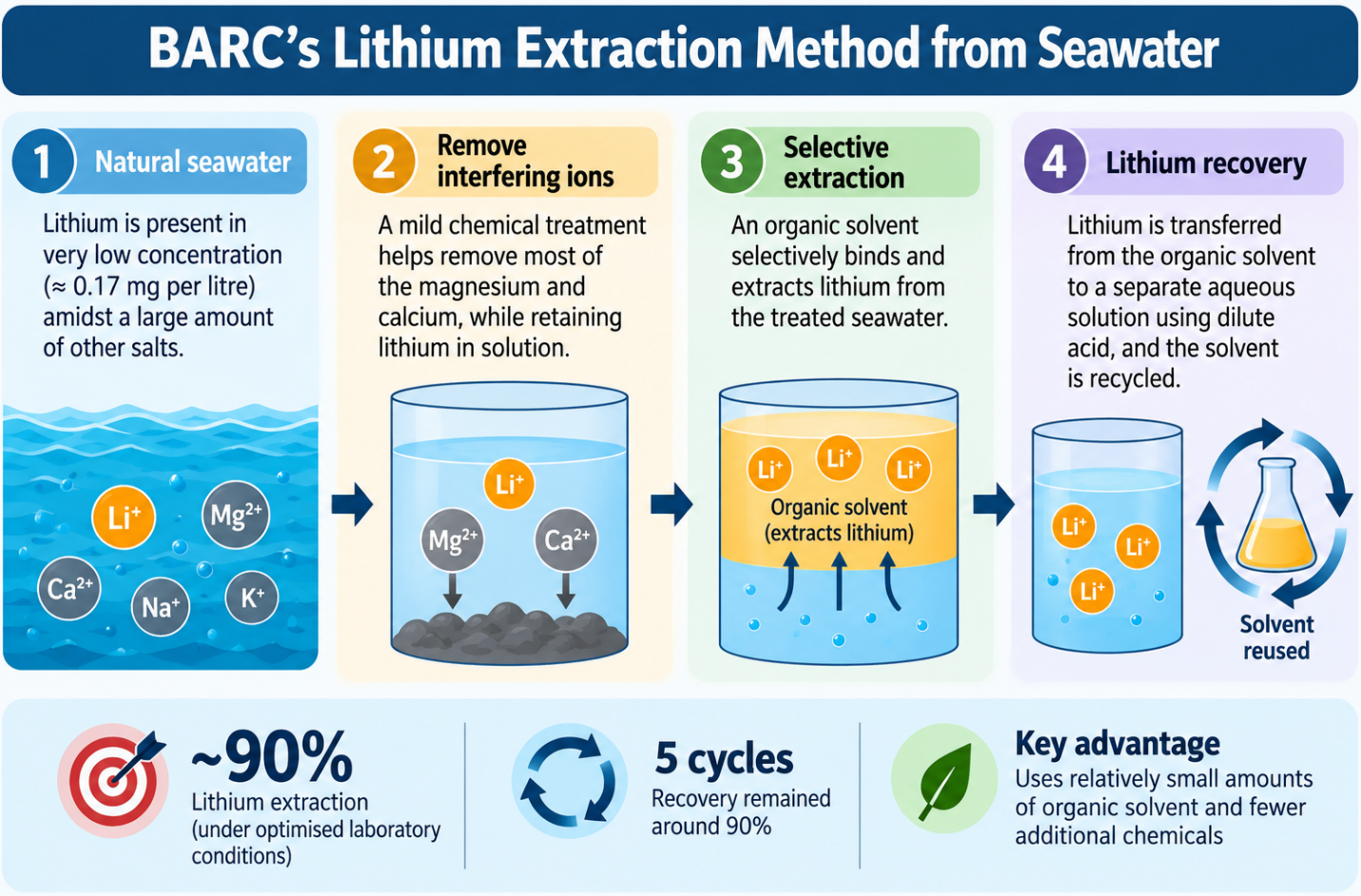
Context: In a scientific breakthrough that can offer the much-needed impetus to India’s energy transition efforts, scientists at Bhabha Atomic Research Centre (BARC) have developed a new technique to efficiently extract lithium from seawater.
More on the News
• Research Development: BARC scientists developed the technique, with their findings published in the scientific journal Talanta.
• Key Achievement: The method achieved approximately 90% lithium extraction from natural seawater under optimised laboratory conditions.
• Distinctive Feature: It uses relatively little organic solvent and fewer additional chemicals, while allowing solvent reuse. However, solvent losses remain a challenge.
Why Is Lithium Extraction from Seawater Challenging?
• Strategic Importance: Lithium is a critical mineral used in lithium-ion batteries for electric vehicles (EVs) and renewable-energy storage systems.
• Vast Resource Potential: Seawater is estimated to contain 180–230 billion tonnes of dissolved lithium, making it an enormous potential resource. This estimate does not represent economically recoverable reserves.
• Low Concentration: Lithium occurs at only about 0.17 mg per litre of seawater, requiring the processing of enormous volumes of water.
• Selective Extraction Challenge: The magnesium-to-lithium ratio exceeds 6,000, making it difficult to separate lithium from competing ions.
• Processing Constraints: Solvent consumption, energy requirements, extraction efficiency and waste management remain important considerations for commercial viability.
Significance of the Achievement
• Diversification of Supply: Seawater extraction could supplement conventional lithium sources and diversify global supply chains.
• Strategic Relevance for India: The technology could eventually support domestic battery manufacturing and reduce vulnerability to import disruptions.
• Promising Process Efficiency: High laboratory-scale recovery, lower solvent requirements and reduced dependence on additional chemical additives make the technique promising.
• Potential Environmental Benefits: Lower chemical consumption and solvent reuse may reduce waste, but the overall environmental advantage remains to be established.
Limitations
• Commercial Scalability: Laboratory results do not establish the method’s economic or technical feasibility at industrial scale.
• Operational Challenges: Approximately 10% of the organic solvent was physically lost per reuse cycle, while persistent emulsion formation during prolonged mixing may affect process efficiency.
• Environmental Concerns: Energy consumption, chemical costs, solvent losses and potential effects on marine ecosystems require further assessment.
Way Ahead
• National R&D Priorities: India should build on NITI Aayog’s recommendation for a national R&D grand challenge on direct lithium extraction from seawater, focusing on higher recovery, lower costs, reduced energy consumption and lower emissions.
• Pilot-Scale Demonstration: The BARC process needs larger-scale testing to assess long-term performance, solvent recovery, operating costs and environmental impacts.
• Desalination Plant Integration: As recommended by NITI Aayog, India should evaluate lithium concentration and extraction economics in discharge streams from seawater desalination plants.
• Global Technology Assessment: Emerging approaches, including ion-selective membranes and electrochemical extraction, should be compared with the BARC method on cost, efficiency and environmental performance.
Khan Global Studies App
With our training programs, learning online can be a very exciting experience. Take the next step toward achieving your professional and personal objectives.



Course Related Query:
Ask Your DoubtsStore Related Query:[email protected]NEET | JEE | CUET
NCERT Books
Resources
We love learning. Through our innovative solutions, we encourage ourselves, our teams, and our Students to grow. We welcome and look for diverse perspectives and opinions because they enhance our decisions. We strive to understand the big picture and how we contribute to the company’s objectives. We approach challenges with optimism and harness the power of teamwork to accomplish our goals. These aren’t just pretty words to post on the office wall. This is who we are. It’s how we work. And it’s how we approach every interaction with each other and our Students.
Come with an open mind, hungry to learn, and you’ll experience unmatched personal and professional growth, a world of different backgrounds and perspectives, and the freedom to be you—every day. We strive to build and sustain diverse teams and foster a culture of belonging. Creating an inclusive environment where every students feels welcome, appreciated, and heard gives us something to feel (really) good about.