You're all caught up—no notifications available.
Explore All Exams at KGS


All Exams
Explore All Exams at KGS

Khan Sir Courses
Geography I Polity I History | World Map I Indian Map I Economics I Biology

UPSC & State PSC
UPSC I BPSC I UP-PSC I MP-PSC

State Exams
UP I Bihar I MP | Rajasthan

NEET | JEE | CUET
NEET | JEE | CUET

Defence Exams
NDA I CDS I CAPF I AFCAT I SSB I Agniveer

Police Exams
UP SI | Bihar SI | Delhi Police | UP Constable

SSC Exams
CGL I CPO I CHSL I MTS I SSC GD I Delhi Police

Foundation Courses
Physics I Chemistry I Biology I History I Geography I Polity I NCERT I Math I English | Map I Reasoning

Railway Exams
RRB | RPF

Teaching Exams
TET | Teaching | UGC

Banking Exams
SBI | RBI | IBPS

Engineering Exams
Civil | Electrical | Mechanical
UGC NET
UGC NET/JRF
Current Affairs provides you with the best compilation of the Daily Current Affairs taking place across the globe: National, International, Sports, Science and Technology, Banking, Economy, Agreement, Appointments, Ranks, and Report and General Studies

SYLLABUS
GS-3: Conservation, Environmental Pollution and Degradation, Environmental Impact Assessment.
GS-2: Important International Institutions, agencies and fora - their Structure, Mandate.
Context: The United Nations has released the Global Forest Goals (GFG) Report 2026, highlighting that global efforts towards sustainable forest management and forest-related Sustainable Development Goals (SDGs) remain inadequate to achieve the 2030 targets.
More on the News
• The Global Forest Goals Report 2026 is the second global assessment report on progress towards achieving the six Global Forest Goals and 26 associated targets under the United Nations Strategic Plan for Forests (UNSPF) 2017–2030.
• The report has been prepared by the United Nations Department of Economic and Social Affairs (UN DESA) and the Secretariat of the United Nations Forum on Forests (UNFF).
• The assessment is primarily based on Voluntary National Reports (VNRs) submitted by 48 countries representing nearly 51% of the global forest area, along with data from FAO’s Global Forest Resources Assessment (FRA) 2025.
• The report was launched during the 21st Session of the United Nations Forum on Forests (UNFF21) held at the UN Headquarters in New York in May 2026.
About the Global Forest Goals (GFGs)
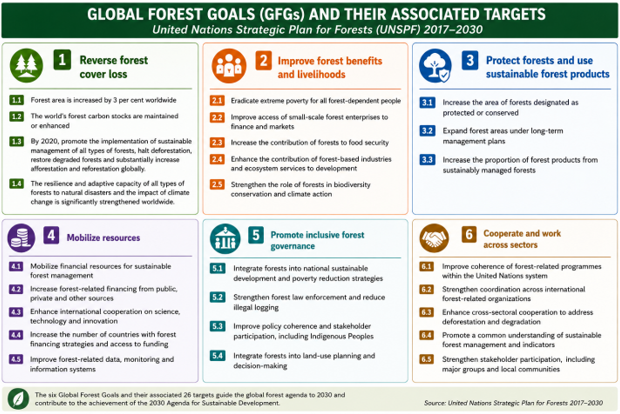
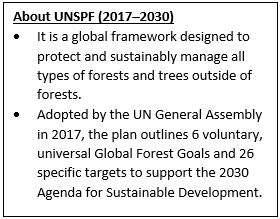
• The Global Forest Goals (GFGs) were adopted under the United Nations Strategic Plan for Forests (UNSPF) 2017–2030 as a universal voluntary framework for sustainable management, conservation, and restoration of all types of forests.
• The framework consists of 6 Global Forest Goals and 26 associated targets to be achieved by 2030.
• The GFGs are closely linked with the Sustainable Development Goals (SDGs), particularly those related to climate action, biodiversity conservation, poverty reduction, food security, ecosystem restoration, and sustainable livelihoods.
Key Findings of the Report
Overall Progress Across Global Forest Goals
• According to the assessment, out of the 26 Global Forest Goal (GFG) targets:
Global Forest Loss Continues
• Global forest area declined by more than 40 million hectares between 2015 and 2025 (from 4.18 billion hectares in 2015 to 4.14 billion hectares in 2025), including the loss of nearly 16 million hectares of primary forests.
• South America recorded the steepest decline, losing 4.1 million hectares annually, while Africa lost nearly 3 million hectares every year.
Poverty and Livelihood Challenges Persist
• The target of eliminating extreme poverty among forest-dependent populations remains off track, particularly in Sub-Saharan Africa, where poverty reduction has remained limited.
• The report estimates that the global formal forest economy is worth nearly USD 1.5 trillion annually, though the contribution of the informal forest economy and ecosystem services remains inadequately measured.
Financing and Governance Gaps
• Global financing for Sustainable Forest Management (SFM) reached approximately USD 84 billion in 2023, far below the estimated annual requirement of nearly USD 300 billion needed by 2030.
• Financing gaps are especially severe in low-income and lower-middle-income countries, where dependence on public funding remains high and innovative financing mechanisms remain underdeveloped.
Policy Recommendations
• Accelerating Forest Conservation: Countries need to strengthen efforts to halt deforestation, reverse forest degradation, protect primary forests, and expand restoration and afforestation initiatives.
• Strengthening Governance and Coordination: Improved forest governance, stricter action against illegal logging, and stronger coordination across sectors such as agriculture, mining, and infrastructure are essential to address deforestation drivers.
• Mobilising Finance and Community Support: Greater public, private, and climate finance is required for sustainable forest management, along with better land tenure security and livelihood support for forest-dependent communities and Indigenous Peoples.
• Improving Data and International Cooperation: Stronger forest monitoring systems, data frameworks, and international cooperation are needed to enhance accountability and accelerate progress towards the Global Forest Goals by 2030.
United Nations Department of Economic and Social Affairs (UN DESA)
• UN DESA is a department of the UN Secretariat that supports international cooperation on sustainable development through policy research, statistical analysis, and capacity-building assistance to member states.
• It also supports the implementation of global development agendas, including the SDGs and forest-related governance frameworks.
United Nations Forum on Forests (UNFF)
• The UNFF is a subsidiary body of the UN Economic and Social Council (ECOSOC) established in 2000 to promote sustainable management and conservation of all types of forests.
• It serves as the principal global intergovernmental platform overseeing implementation of the United Nations Strategic Plan for Forests (UNSPF).
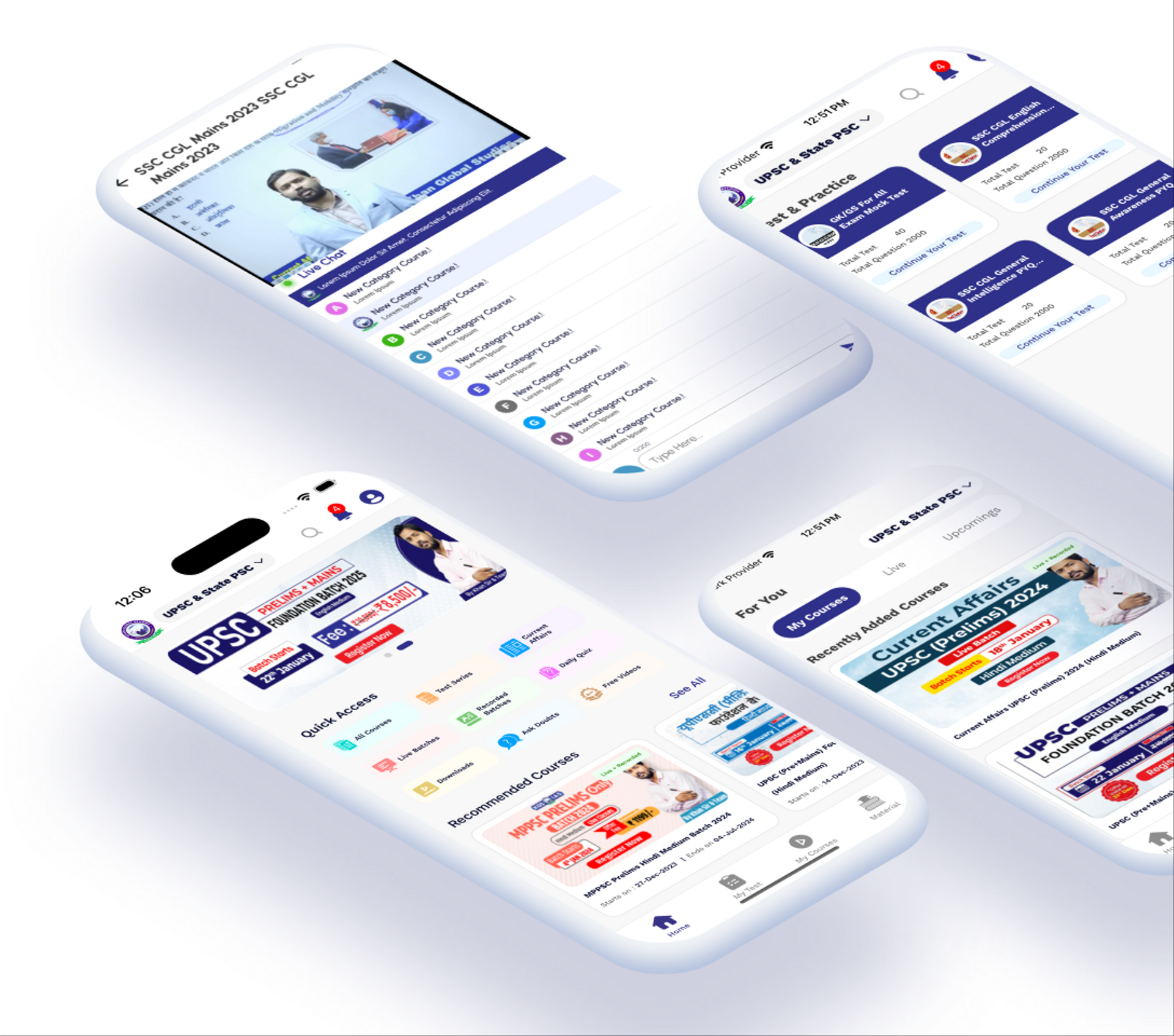
The most trusted learning platform on your phone
With our training programs, learning online can be a very exciting experience! Take the next step toward achieving your professional and personal objectives


Course Related Query:
Ask Your DoubtsStore Related Query:[email protected]NCERT Books
Resources
We love learning. Through our innovative solutions, we encourage ourselves, our teams, and our Students to grow. We welcome and look for diverse perspectives and opinions because they enhance our decisions. We strive to understand the big picture and how we contribute to the company’s objectives. We approach challenges with optimism and harness the power of teamwork to accomplish our goals. These aren’t just pretty words to post on the office wall. This is who we are. It’s how we work. And it’s how we approach every interaction with each other and our Students.
Come with an open mind, hungry to learn, and you’ll experience unmatched personal and professional growth, a world of different backgrounds and perspectives, and the freedom to be you—every day. We strive to build and sustain diverse teams and foster a culture of belonging. Creating an inclusive environment where every students feels welcome, appreciated, and heard gives us something to feel (really) good about.
Get Free academic Counseling & Course Details