Current Affairs provides you with the best compilation of the Daily Current Affairs taking place across the globe: National, International, Sports, Science and Technology, Banking, Economy, Agreement, Appointments, Ranks, and Report and General Studies
NEWS IN SHORT
Incorporation of Battery Energy Storage in PM-KUSUM 2.0
Context: The Government is considering incorporating a battery energy storage system in the revamped PM-KUSUM 2.0 scheme.
More on the News
Revamped Scheme: A revamped version of the PM-KUSUM scheme, termed PM-KUSUM 2.0, is being considered by the government to address the existing shortcomings and enhance overall efficiency.
Incorporation of Battery Storage: The current scheme focuses on solarisation of agricultural pumps but lacks battery storage. Its inclusion is being considered to address the mismatch between solar generation and agricultural power demand.
Timeframe Revision: The Centre has extended the deadlines for financial closure and project completion under the existing scheme in response to delays faced by stakeholders, particularly in securing financing from financial institutions.
Shift towards PM-KUSUM 2.0: The existing scheme is likely to be subsumed under the upcoming PM-KUSUM 2.0 framework, with states being advised to coordinate closely with financial institutions to expedite pending projects ahead of the transition.
Rationale for Battery Storage in PM-KUSUM 2.0
The integration of battery storage is primarily driven by the mismatch between solar power generation and agricultural electricity demand patterns:
Agricultural Load Profile: Farm power demand generally begins in the morning, remains consistent during the day, and often extends beyond sunset.
Solar Generation Pattern: Solar output peaks around midday and declines sharply in the evening hours.
Proposed Solution: Battery Energy Storage Systems (BESS) can store excess solar energy generated during peak sunlight hours and supply it when generation declines, but irrigation demand persists. This helps enhance grid stability and ensures a more reliable power supply for farmers.
Policy Deliberations: While the Ministry of Power has proposed up to four hours of storage capacity, the Ministry of New and Renewable Energy (MNRE) has recommended a two-hour storage provision for the initial phase of implementation.
About PM KUSUM (PM Kisan Urja Suraksha evam Utthaan Mahabhiyaan)
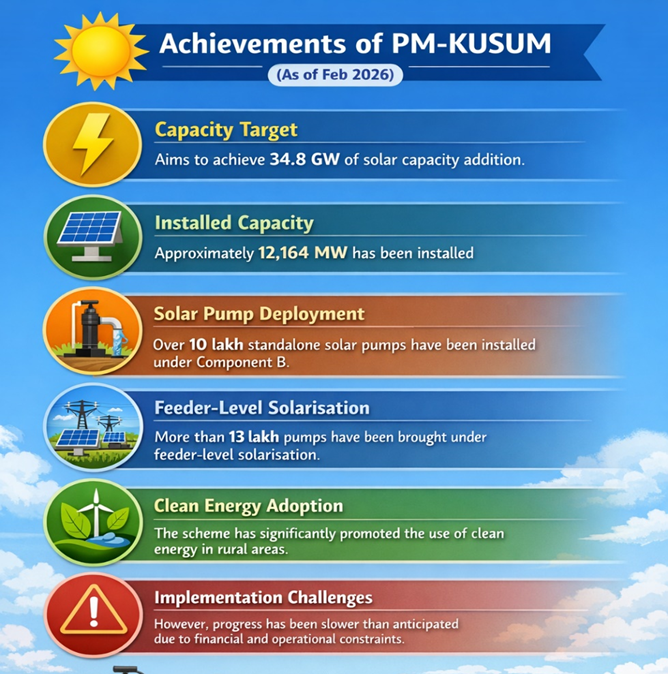
Launched in March 2019, it is a flagship initiative of the Ministry of New and Renewable Energy (MNRE).
It aims to ensure energy security for farmers, reduce dependence on diesel in agriculture, and augment farmers’ income through the adoption of solar energy.
Three Components of PM-KUSUM:
Component A: Decentralised solar plants
Component B: Standalone solar pumps
Component C: Solarisation of grid-connected pumps
Earth Hour 2026
Context: On March 28, 2026, people in over 190 countries and regions observed 'Earth Hour' from 8:30 PM to 9:30 PM local time, marking its 20th anniversary.
About the Earth Hour Initiative
It is a global grassroots initiative that brings individuals together to act on environmental concerns and safeguard the planet, urging them to switch off their lights for one hour, from 8:30 p.m. to 9:30 p.m. local time on the last Saturday of March, to spread awareness about climate change and promote energy conservation.
Organiser: World Wide Fund for Nature (WWF)
Organiser in India: WWF India, in collaboration with the Ministry of Environment, Forest and Climate Change (MoEFCC)
Theme 2026: "Give an Hour for Earth"
Origin: It originated in Sydney, Australia, in 2007 as a symbolic “lights-off” event and has since expanded into a worldwide campaign involving millions across more than 190 countries and territories.
Extracellular RNA (exRNA)
Context: Recently, scientists reported that extracellular RNA (exRNA) from bacteria can persist in disinfected drinking water.
About Extracellular RNA (exRNA)
Extracellular RNA (exRNA) refers to RNA molecules that exist outside the cells in which they were originally synthesised.
While traditional biology emphasised the intracellular role of RNA in protein synthesis, the concept of exRNA has brought about a significant conceptual shift by highlighting its role in intercellular communication.
Occurrence in Body Fluids: It is widely distributed across various biological fluids, including blood (plasma/serum), saliva, urine, breast milk, and cerebrospinal fluid.
RNA Types: exRNA comprises a heterogeneous mix of RNA species, including both coding RNA (mRNA) and non-coding RNA such as miRNA, siRNA, etc.
Significance of exRNA
Mediator of Intercellular Communication: exRNA functions as a long-range signalling molecule, enabling cells to transmit genetic information to other cells, and influencing their activity, gene expression, and protein synthesis.
Immune Regulation: It plays a crucial role in coordinating immune responses, including reactions to infections, tissue repair processes, and overall development.
Biomarker for Diseases: Changes in the exRNA profile during disease states make it a promising "liquid biopsy" tool, aiding in the early-stage detection of cancer, cardiovascular diseases, and neurodegenerative disorders without the need for any invasive procedures.
Therapeutic Applications: Research institutions and start-ups are exploring the potential of exRNA in developing innovative therapies for both communicable and non-communicable diseases.
IONS Maritime Exercise (IMEX) TTX 2026
Context: Recently, the Indian Navy conducted the IONS Maritime Exercise (IMEX) TTX 2026 at the Maritime Warfare Centre, Southern Naval Command, Kochi.
About the Exercise
Key Objectives:
To deepen mutual understanding of operational practices and associated constraints.
To assess coordination frameworks, including mechanisms for information exchange and decision-making.
To facilitate the refinement and validation of IONS maritime security guidelines through practical implementation.
Participants: Senior representatives from the navies of IONS member states, international officers associated with IOS SAGAR, and personnel from the Indian Navy.
Participating countries: Bangladesh, France, Indonesia, Kenya, Maldives, Mauritius, Myanmar, Seychelles, Singapore, Sri Lanka, Tanzania and Timor-Leste.
Significance: The exercise underscored the importance of IONS as a vital platform for fostering regional maritime cooperation and is anticipated to enhance security frameworks while promoting stability across the Indian Ocean Region.
About Indian Ocean Naval Symposium (IONS)
It is a voluntary initiative aimed at enhancing maritime cooperation among the navies of littoral states in the Indian Ocean Region (IOR) by providing an open and inclusive platform for dialogue on regional maritime issues.
It seeks to facilitate the exchange of information among naval professionals, fostering shared understanding and collaborative solutions to common challenges.
Membership: The grouping presently includes 25 member countries and 9 observer nations.
India’s Role: The initiative was conceptualised by the Indian Navy in 2008.
Chairmanship: The chair rotates biennially among member states, with the selection based on mutual consensus.
India’s Chairmanship: India assumed the Chairmanship of IONS on 20 February 2026 after 17 years.
Bio-Bitumen Technology
Context: The Council of Scientific and Industrial Research (CSIR) organised a technology transfer event titled “Bio-Bitumen from Lignocellulosic Biomass – From Farm Residue to Roads” in New Delhi to promote industry adoption of its innovation.
About Bio-Bitumen
Bio-bitumen is produced from renewable organic sources such as plant-derived oils, agricultural residues, and other biomass, which are processed through specialised techniques to create a high-quality binder comparable to conventional bitumen.
It serves as a sustainable alternative to petroleum-based bitumen, thereby reducing both carbon emissions and dependence on imports.
Its production process involves several stages, which may vary depending on the type of raw materials used.
Its production leads to substantially lower carbon emissions, making it suitable for environmentally sustainable infrastructure projects.
Bio-Bitumen Production Mechanism
Feedstock Collection and Pre-processing: Raw materials such as plant-based oils, lignin, and algae are gathered and subjected to initial processing.
Pyrolysis: Biomass undergoes controlled thermal decomposition to generate bio-oil, which serves as the primary precursor for bio-bitumen.
Refinement and Upgrading: The extracted bio-oil is refined and chemically modified to improve key characteristics such as viscosity, thermal stability, and adhesive strength.
Blending: In some cases, bio-bitumen is blended with conventional bitumen to optimise performance while preserving its sustainability benefits.
About the Indigenous Technology
The technology has been developed by CSIR–Central Road Research Institute (CSIR-CRRI), New Delhi, and CSIR–Indian Institute of Petroleum (CSIR-IIP), Dehradun.
It involves the collection of post-harvest rice straw, followed by its pelletisation and conversion into bio-oil through pyrolysis.
The resulting bio-oil is then blended with conventional bitumen for practical use.
Laboratory tests have demonstrated that 20–30 per cent of conventional bitumen can be replaced without compromising performance.
Energy Statistics India 2026
Context: Recently, the National Statistics Office (NSO) released the annual publication “Energy Statistics India 2026”
More on the News
It is an integrated dataset covering key aspects of reserves, capacity, production, consumption, and trade of major energy commodities in India, including coal, lignite, petroleum, natural gas, and renewables.
The 33rd edition has enhanced its coverage by incorporating aspects like Credit Flow to domestic energy sectors, world energy statistics, etc.
Key Findings of the Report
Growth in Total Primary Energy Supply (TPES): During FY 2024–25, India’s TPES grew by 2.95%, reaching 9,32,816 KToE (Kilo Tonnes of oil Equivalent), indicating steady expansion in the energy sector.
Surge in Renewable Energy Potential: India’s renewable energy potential reached 47,04,043 MW (as of March 2025).
Renewables Contribution: Solar (33,43,378 Megawatt) has the highest share (around 71%), followed by Wind Power (11,63,856 Megawatt) and Large Hydro (1,33,410).
Concentration of Renewable Energy Potential: Over 70% of India’s renewable energy potential is concentrated in six states—Rajasthan (23.70%), Maharashtra (14.26%), Gujarat (9.10%), Andhra Pradesh (9.1%), Karnataka (8.59%), and Madhya Pradesh (8.09%).
Growth in Renewable Energy Installed Capacity: Installed renewable energy capacity rose from 90,134 MW (2016) to 2,29,346 MW (2025), registering a CAGR of 10.93%.
Rise in Renewable Electricity Generation: Renewable electricity generation increased from 1,89,314 GWh (2015–16) to 4,16,823 GWh (2024–25), recording a CAGR of 9.17%.
Increase in Per Capita Energy Consumption: Per capita energy consumption rose from 15,296 MJ/person (2015–16) to 18,096 MJ/person (2024–25), with a CAGR of 1.89%.
Dominance of Coal in Energy Supply: Coal (including lignite) remains the primary energy source, with supply rising from 3,87,761 KToe (2015–16) to 5,52,315 KToe (2024–25), while other sources like crude oil and natural gas have also grown steadily.
Rise in Total Final Energy Consumption (TFC): TFC increased by 30.41%, from 4,69,212 KToe (2015–16) to 6,08,578 KToe (2024–25), reflecting growing end-use demand.
Surge in Credit Flow to Energy Sector: Credit flow rose over sixfold, from ₹1,688 crore (2021) to ₹10,325 crore (2025), indicating increased financial support to the sector.
With our training programs, learning online can be a very exciting experience! Take the next step toward achieving your professional and personal objectives
We love learning. Through our innovative solutions, we encourage ourselves, our teams, and our Students to grow. We welcome and look for diverse perspectives and opinions because they enhance our decisions. We strive to understand the big picture and how we contribute to the company’s objectives. We approach challenges with optimism and harness the power of teamwork to accomplish our goals. These aren’t just pretty words to post on the office wall. This is who we are. It’s how we work. And it’s how we approach every interaction with each other and our Students.
What Makes Us Different
Come with an open mind, hungry to learn, and you’ll experience unmatched personal and professional growth, a world of different backgrounds and perspectives, and the freedom to be you—every day. We strive to build and sustain diverse teams and foster a culture of belonging. Creating an inclusive environment where every students feels welcome, appreciated, and heard gives us something to feel (really) good about.