You're all caught up—no notifications available.
Explore All Exams at KGS


All Exams
Explore All Exams at KGS

Khan Sir Courses
Geography I Polity I History | World Map I Indian Map I Economics I Biology

UPSC & State PSC
UPSC I BPSC I UP-PSC I MP-PSC

State Exams
UP I Bihar I MP | Rajasthan

NEET | JEE | CUET | Boards
NEET | JEE | CUET | Boards

Defence Exams
NDA I CDS I CAPF I AFCAT I SSB I Agniveer

Police Exams
UP SI | Bihar SI | Delhi Police | UP Constable

SSC Exams
CGL I CPO I CHSL I MTS I SSC GD I Delhi Police

Foundation Courses
Physics I Chemistry I Biology I History I Geography I Polity I NCERT I Math I English | Map I Reasoning

Railway Exams
RRB | RPF

Teaching Exams
TET | Teaching | UGC

Banking Exams
SBI | RBI | IBPS

Engineering Exams
Civil | Electrical | Mechanical
UGC NET
UGC NET/JRF
Current Affairs provides you with the best compilation of the Daily Current Affairs taking place across the globe: National, International, Sports, Science and Technology, Banking, Economy, Agreement, Appointments, Ranks, and Report and General Studies

SYLLABUS
GS-2: Bilateral, regional, and global groupings and agreements involving India and/or affecting India’s interests.
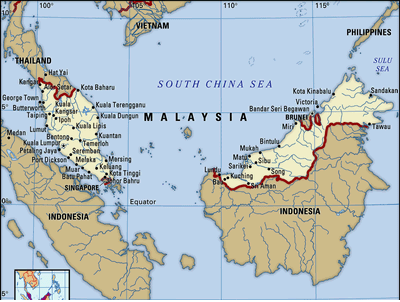
Context: At the invitation of Malaysian Prime Minister Anwar Ibrahim, Prime Minister Narendra Modi undertook an official visit to Malaysia.
More on the News
• The visit reaffirmed the shared commitment of both leaders to consolidate and expand the India–Malaysia Comprehensive Strategic Partnership (CSP), which was elevated in August 2024.
• The leaders witnessed the exchange of 11 agreements/MoUs, aimed at strengthening institutional cooperation across multiple sectors.
• The visit helped reinforce momentum in bilateral ties after some diplomatic unease in 2025 and reaffirmed India’s strong commitment to ASEAN centrality and the Indo-Pacific.
Key Highlights of Visit
• 11 agreements/MoUs signed, covering semiconductors, disaster management, UN peacekeeping, healthcare, national security, vocational education (TVET), social security for Indian workers, counter-corruption, and audio-visual co-production.
• Strong and explicit condemnation of terrorism, including cross-border terrorism, with both leaders stressing “no double standards, no compromise” and pledging cooperation at the UN and FATF.
• Agreement to deepen semiconductor cooperation, building on collaboration between IIT-Madras Global and Malaysia’s Advanced Semiconductor Academy, and industry bodies from both sides.
• Renewed push for local-currency settlement in trade using the Indian Rupee and Malaysian Ringgit, alongside payment linkages between NPCI International Limited and PayNet Malaysia.
• Commitment to expand bilateral trade beyond $18.6 billion, enhance investments, and strengthen supply chains in food, energy, and critical technologies.
• Emphasis on Indo-Pacific peace and stability, freedom of navigation, and dispute resolution in accordance with UNCLOS 1982.
• Support for ASEAN centrality, early completion of the ASEAN–India Trade in Goods Agreement (AITIGA) review, and closer coordination in multilateral forums.
India–Malaysia Bilateral Relations
|
Historical Background: |
·
India
established diplomatic relations with the Federation of Malaya (predecessor
of Malaysia) in 1957. ·
Bilateral ties
were elevated to a Strategic Partnership in 2010. ·
Relations were
further upgraded to an Enhanced Strategic Partnership during
the visit of PM Narendra Modi in 2015. ·
Under India’s Act
East Policy (2014), Malaysia has emerged as a key partner for
India’s engagement with ASEAN and the Asia-Pacific.
|
|
Economic and Commercial Relations: |
·
Malaysia is India’s
third-largest trading partner in ASEAN. ·
The ASEAN–India
Agreements on Trade in Services and Investment came into force in 2015. ·
A bilateral Comprehensive
Economic Cooperation Agreement (CECA) has been in effect since July
2011. ·
India’s
major exports to Malaysia
include petroleum products, machinery, chemicals, cereals, electrical
equipment, and spices. ·
India’s
major imports from Malaysia
include palm oil, petroleum products, machinery, electronics, rubber, and
aluminium. ·
Bilateral trade
stood at around USD 19.9 billion in 2024–25.
|
|
Defence and Security Cooperation: |
·
Defence
cooperation is anchored in the 1993 MoU on Defence Cooperation,
amended in 2023. ·
India and
Malaysia conduct regular army, navy, and air force exercises,
including Harimau Shakti, Samudra Laksamana, and Udara
Shakti. ·
The Indian Navy
and Coast Guard regularly undertake port calls and maritime cooperation
with Malaysia. ·
India
inaugurated HAL’s first regional office in Kuala Lumpur in 2023. ·
Both Leaders
appreciated India's steadfast engagement in the ASEAN Defence
Ministers' Meeting Plus framework and welcomed the co-chairmanship
with Malaysia of the Counter-Terrorism Working Group for the 2024-2027
term. |
|
Education & Skill Development:
|
·
Both Leaders
noted the large number of students in each other’s countries
and ongoing cooperation under the Malaysia Technical Cooperation
Programme (MTCP) and Indian Technical and Economic Cooperation
Programme (ITEC). ·
Prime Minister
Narendra Modi invited Malaysian students to avail opportunities under the ‘Study
in India’ Programme.
|
|
Cooperation in Sustainable Development: |
·
Both Leaders
underscored shared commitment to biodiversity conservation,
noting Malaysia’s role as a founding member of the International Big
Cat Alliance (IBCA). ·
Cooperation
will continue under the MoU between the National Disaster Management
Authorities of both countries. ·
Leaders
acknowledged regional and international initiatives, including the Coalition
for Disaster Resilient Infrastructure (CDRI).
|
|
Indian Diaspora: |
·
Malaysia hosts
approximately 2.75 million PIOs, which is the second-largest
PIO community in the world after the US. ·
Malaysia has
the third-largest Indian diaspora in the world (2.9 mn). |
Significance of Malaysia for India
• Strategic Counterweight to China in Southeast Asia: Malaysia occupies a critical geopolitical space amid China’s expanding economic and maritime footprint.
• Maritime & Indo-Pacific Security Anchor: Located astride the Strait of Malacca, Malaysia is vital to freedom of navigation and regional sea-lane security.
• Pillar of Act East Policy & ASEAN Centrality: As a key ASEAN member, Malaysia strengthens India’s Act East engagement and helps preserve ASEAN Centrality against unilateral, China-centric regional architectures—keeping the Indo-Pacific inclusive and rules-based.
• China-Plus-One Supply Chain Diversification: Malaysia’s strength in electronics and semiconductor back-end manufacturing complements India’s design and fabrication ambitions, enabling resilient, non-China supply chains and reducing exposure to economic coercion.
Source :-
PIB
MEA
Business Standard
The most trusted learning platform on your phone
With our training programs, learning online can be a very exciting experience! Take the next step toward achieving your professional and personal objectives



Course Related Query:
Ask Your DoubtsStore Related Query:[email protected]NCERT Books
Resources
We love learning. Through our innovative solutions, we encourage ourselves, our teams, and our Students to grow. We welcome and look for diverse perspectives and opinions because they enhance our decisions. We strive to understand the big picture and how we contribute to the company’s objectives. We approach challenges with optimism and harness the power of teamwork to accomplish our goals. These aren’t just pretty words to post on the office wall. This is who we are. It’s how we work. And it’s how we approach every interaction with each other and our Students.
Come with an open mind, hungry to learn, and you’ll experience unmatched personal and professional growth, a world of different backgrounds and perspectives, and the freedom to be you—every day. We strive to build and sustain diverse teams and foster a culture of belonging. Creating an inclusive environment where every students feels welcome, appreciated, and heard gives us something to feel (really) good about.
Get Free academic Counseling & Course Details