You're all caught up—no notifications available.
Explore All Exams at KGS


All Exams
Explore All Exams at KGS

Khan Sir Courses
Geography I Polity I History | World Map I Indian Map I Economics I Biology

UPSC & State PSC
UPSC I BPSC I UP-PSC I MP-PSC

State Exams
UP I Bihar I MP | Rajasthan

NEET | JEE | CUET | Boards
NEET | JEE | CUET | Boards

Defence Exams
NDA I CDS I CAPF I AFCAT I SSB I Agniveer

Police Exams
UP SI | Bihar SI | Delhi Police | UP Constable

SSC Exams
CGL I CPO I CHSL I MTS I SSC GD I Delhi Police

Foundation Courses
Physics I Chemistry I Biology I History I Geography I Polity I NCERT I Math I English | Map I Reasoning

Railway Exams
RRB | RPF

Teaching Exams
TET | Teaching | UGC

Banking Exams
SBI | RBI | IBPS

Engineering Exams
Civil | Electrical | Mechanical
UGC NET
UGC NET/JRF
Current Affairs provides you with the best compilation of the Daily Current Affairs taking place across the globe: National, International, Sports, Science and Technology, Banking, Economy, Agreement, Appointments, Ranks, and Report and General Studies

SYLLABUS
GS-2: Bilateral, regional, and global groupings and agreements involving India and/or affecting India’s interests.
Context: The United States of America (U.S.) and India have reached a framework for an Interim Agreement on reciprocal and mutually beneficial trade, marking a major recalibration of bilateral trade relations.
More on the News
• The framework advances negotiations toward a comprehensive India–U.S. Bilateral Trade Agreement (BTA) launched on 13 February 2025 by President Donald J. Trump and Prime Minister Narendra Modi.
• It focuses on reciprocal tariff rationalisation, market access expansion, digital trade cooperation, supply chain resilience, and economic security alignment.
• India’s exports to the U.S. stood at USD 86.35 billion in 2024, and the agreement restructures tariff treatment across a significant portion of this trade basket.
• The deal balances export competitiveness with safeguards for farmers, MSMEs, and domestic manufacturing.
Key Highlights of the Deal
• U.S. Actions:
• Indian Actions:
• Tariff Rationalisation on Indian Exports: Of USD 40.96 billion exports earlier subject to Reciprocal Tariffs (up to 50%), USD 30.94 billion has been reduced from 50% to 18%, while USD 10.03 billion now attracts zero duty.
• Zero-Duty Agricultural Access: Zero additional duty has been granted on USD 1.36 billion agricultural exports, with USD 1.035 billion assured zero Reciprocal Tariff.
• Sector-Specific Gains
• Digital & Technology Cooperation: Enhanced trade in GPUs, semiconductor chips, data centre equipment, and AI processors, along with streamlined ICT licensing.
• Non-Tariff Barrier Reduction: India will address barriers related to medical devices, ICT import licensing, and food & agricultural standards.
• Rules of Origin & Safeguards: Strong Rules of Origin provisions ensure benefits primarily accrue to India and the U.S.
Significance of India–U.S. Tariff Rationalisation
• Enhanced Price Competitiveness: India gains tariff advantages over competitors such as China (35%), Vietnam (20%), Bangladesh (20%), and Malaysia (19%), strengthening its position in labour-intensive and high-value sectors.
• Export Expansion into USD 30 Trillion Market: The agreement secures sustained preferential access to the world’s largest consumer market, enabling scale expansion across textiles, leather, machinery, agriculture, and technology goods.
• Boost to MSMEs and Employment: Significant tariff reductions in labour-intensive sectors strengthen MSME clusters and promote employment generation.
• Integration into Global Value Chains: Improved access to critical intermediate inputs such as semiconductor wafers, specialty chemicals, and aerospace components enhances manufacturing depth and supports export-led growth under Make in India.
• Digital & Strategic Technology Leap: Reliable access to AI chips, cloud hardware, and advanced digital equipment strengthens India’s data centre ecosystem and technological competitiveness.
• Balanced Agricultural Liberalisation: The framework protects sensitive farm sectors while expanding agricultural exports without exposing farmers to import shocks.
India–United States Bilateral Relations
|
Historical Relations: |
·
India and the
United States established diplomatic relations in 1947. ·
The
relationship deepened significantly after the 2005 Civil Nuclear
Agreement. ·
In 2016, the
U.S. designated India as a Major Defense Partner (MDP). ·
On 13 February
2025, leaders launched the U.S.-India COMPACT initiative during PM
Modi’s visit to Washington DC. |
|
Economic Relations: |
·
The United
States is India’s largest trading partner. ·
Total bilateral
trade in goods and services reached $190.1 billion in 2023. ·
India’s exports
to the U.S. were about $120 billion in 2023. ·
U.S. exports to
India were about $70 billion in 2023. ·
Both countries
launched “Mission 500” to raise trade to $500 billion by 2030. ·
The U.S. was
the third-largest source of FDI into India in FY 2023–24. |
|
Defence Relations: |
·
India signed
key agreements such as LEMOA (2016), COMCASA (2018), and BECA (2020). ·
India has
purchased more than $20 billion worth of U.S. defence
equipment. ·
Major platforms
include C-17 aircraft, C-130J aircraft, Apache helicopters, Chinook
helicopters, and P-8I aircraft. ·
India signed a
deal to procure MQ-9B Reaper drones in 2024. ·
Important
exercises include Yudh Abhyas, Malabar, Cope India, Vajra Prahar, and
Tiger Triumph. ·
The Initiative
on Critical and Emerging Technology (iCET) strengthens
cooperation in AI, quantum, semiconductors, and defence technology. |
|
Clean Energy Relations: |
·
India and the
U.S. launched the Climate and Clean Energy Agenda 2030 in 2021. ·
The partnership
includes the Strategic Clean Energy Partnership (SCEP). ·
Cooperation
covers renewable energy, hydrogen, biofuels, energy storage, and civil
nuclear energy. ·
Both countries
agreed to unlock $1 billion in multilateral financing for
clean energy supply chains. ·
The Green
Transition Fund is being anchored by India’s NIIF and the U.S. DFC. ·
Hydrocarbon
trade between the two countries reached $13.6 billion in FY 2023–24.
|
|
Space Relations: |
·
The two
countries are jointly developing the NISAR Earth observation satellite. ·
The NASA–ISRO
Synthetic Aperture Radar (NISAR) satellite was successfully launched on 30
July 2025 from Sriharikota. ·
NASA supported
India’s Chandrayaan-2 and Chandrayaan-3 missions. ·
ISRO and NASA
signed agreements for cooperation in human spaceflight in 2024. |
|
Indian Diaspora: |
·
About 4.4
million Indian Americans and Persons of Indian Origin live in the
U.S. ·
About 300,000
Indian students are studying in the U.S. as of January 2025. ·
Indian students
contribute about $8 billion annually to the U.S. economy. |
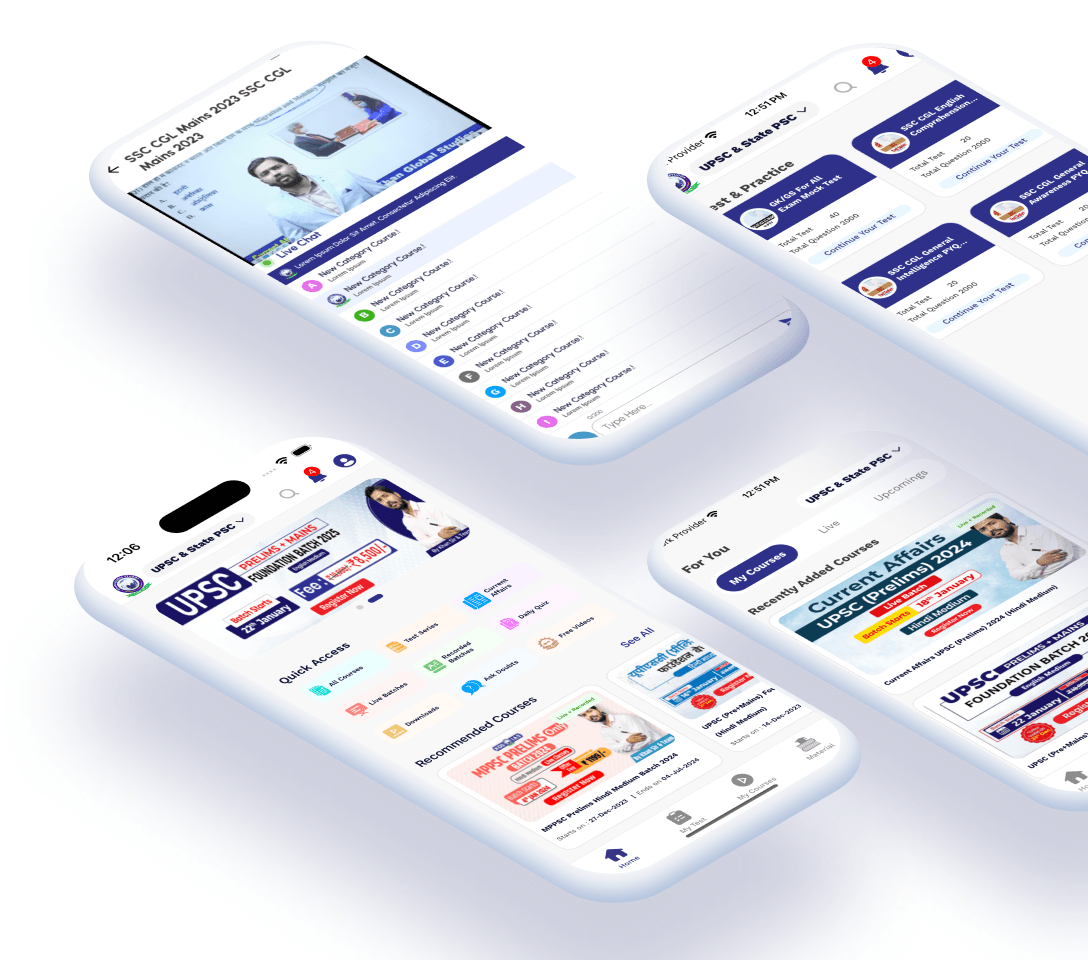
The most trusted learning platform on your phone
With our training programs, learning online can be a very exciting experience! Take the next step toward achieving your professional and personal objectives



Course Related Query:
Ask Your DoubtsStore Related Query:[email protected]NCERT Books
Resources
We love learning. Through our innovative solutions, we encourage ourselves, our teams, and our Students to grow. We welcome and look for diverse perspectives and opinions because they enhance our decisions. We strive to understand the big picture and how we contribute to the company’s objectives. We approach challenges with optimism and harness the power of teamwork to accomplish our goals. These aren’t just pretty words to post on the office wall. This is who we are. It’s how we work. And it’s how we approach every interaction with each other and our Students.
Come with an open mind, hungry to learn, and you’ll experience unmatched personal and professional growth, a world of different backgrounds and perspectives, and the freedom to be you—every day. We strive to build and sustain diverse teams and foster a culture of belonging. Creating an inclusive environment where every students feels welcome, appreciated, and heard gives us something to feel (really) good about.
Get Free academic Counseling & Course Details